

2026–2027 Astrology: A Rare Planetary Threshold, the North Node and How to Navigate Change Without Fear
Last updated: September 13, 2026

There are periods when astrology feels less like a collection of isolated transits and more like a sky full of overlapping themes. 2026 is one of those periods. So is 2027.
Pluto is moving through Aquarius. Neptune has returned to Aries. Uranus has returned to Gemini. Saturn and Neptune completed an exact conjunction at the opening degree of Aries in February 2026. During July, Jupiter briefly joined Uranus, Neptune and Pluto in an unusually precise geometric pattern. The three slower outer planets remain connected, and another especially tight phase arrives in June 2027.
For astrologers, those movements invite enormous language: new eras, technological acceleration, spiritual renewal, collapsing structures, radical communication, collective awakening and even a transformation in what it means to be human.
Some people find that language inspiring. Others find it unsettling. And many simply want to know what is actually happening in the sky beneath the predictions.
That is where this guide begins.
Quick answer
Yes, 2026–2027 contains an unusually striking cluster of outer-planet alignments. The planetary positions and aspect dates are calculable. What those alignments mean is astrological interpretation rather than a scientifically established effect on human consciousness or world events. A useful approach is to understand the pattern, explore its symbolism and keep your own judgment firmly in the room.
Disclosure: This article contains affiliate links. Mindelly may earn a commission when you use certain links, at no additional cost to you.
First, separate the sky from the story we tell about it
Astrological conversations become much easier to navigate when three different layers are kept distinct.
Three layers to keep separate
- Astronomical or ephemeris fact: planetary positions, orbital cycles and the angles planets form can be calculated.
- Astrological interpretation: astrologers give symbolic meanings to planets, signs, houses and aspects.
- Spiritual belief or personal experience: concepts such as soul contracts, energetic upgrades, galactic consciousness and a light body belong to metaphysical frameworks rather than established physical science.
Keeping those layers separate does not require abandoning astrology. It can make astrology more useful because we no longer need every symbolic idea to masquerade as a scientific law before we are allowed to explore it.
A symbol can prompt reflection. A ritual can mark a transition. A birth chart can provide a language for discussing personality, conflict or change. Those experiences belong to a different category from proving that planets physically cause events in an individual’s life.
Mainstream science has not established astrology as a reliably predictive or causal system. One of the best-known controlled tests, Shawn Carlson’s double-blind experiment published in Nature in 1985, did not support natal astrologers’ ability to match personality profiles under the study conditions.
That scientific background matters. So does intellectual humility in the opposite direction. A person’s cultural, spiritual or personal relationship with astrology is not identical to a laboratory claim about planetary causation.
For the rest of this article, we can hold both ideas at once.
Why astrologers are paying so much attention to 2026 and 2027
The strongest case for treating this as a distinctive astrological period does not depend on one dramatic prediction. It comes from several slow planetary cycles overlapping.

Astrodienst has highlighted a long-running configuration involving Pluto, Neptune and Uranus. From roughly 2024 through 2029, Neptune and Pluto form a sextile, Uranus and Neptune form another sextile, and Uranus and Pluto form a trine.
Because Uranus, Neptune and Pluto move slowly, their relationships develop over years. They do not behave like a Moon transit that appears and disappears in hours. They approach an angle, become exact, separate, return because of retrograde motion and gradually move apart again.
The pattern becomes particularly precise during three windows: August 24–September 10, 2025; July 10–25, 2026; and June 10–18, 2027. During those windows, all three major aspects come within roughly half a degree of exactness.
The July 2026 phase became even more visually striking because Jupiter entered the geometry. From approximately July 18–22, Jupiter in Leo was simultaneously near a sextile to Uranus, a trine to Neptune and an opposition to Pluto while Uranus, Neptune and Pluto maintained their interlocking pattern.
What do sextile, trine, conjunction and opposition actually mean?
Astrological aspect language can make a simple geometric idea sound much more mysterious than it is.
An aspect is the angular relationship between two positions in the zodiac. Astrologers interpret different angles as describing different kinds of interaction.
The four aspect types that matter most in this article
- Conjunction — approximately 0°: two planets occupy nearly the same zodiac position. Astrologers usually read their symbolism as strongly combined.
- Sextile — approximately 60°: traditionally considered a cooperative aspect associated with opportunity, exchange and possibilities that often require participation.
- Trine — approximately 120°: traditionally interpreted as flowing or supportive. Its symbolism can operate easily, sometimes so easily that it is taken for granted.
- Opposition — approximately 180°: two positions face one another across the zodiac. Astrologers often associate this with polarity, tension, awareness and the need to negotiate competing forces.
The 2026–2027 Uranus–Neptune–Pluto structure is dominated by sextiles and a trine rather than squares and oppositions. That is one reason many astrologers describe it as unusually constructive or creative rather than automatically catastrophic.
But “harmonious” does not mean “nothing difficult happens.” A trine between two powerful planets can describe change that moves with surprising momentum. A sextile can symbolize an opening that becomes useful only after somebody acts on it.
Astrological tradition also uses an orb: the allowed distance from an exact aspect. If two planets are one degree away from a precise trine, an astrologer may still treat the trine as active. Slow planets can remain in a meaningful orb for long periods.
That explains why exact dates matter without making them magical deadlines.
Worth knowing
You may see the July 2026 configuration called a “basket,” “cradle” or “Barbault” pattern online. The naming is not completely standardized. The useful part is the geometry itself: Jupiter briefly connected with the longer-running Uranus–Neptune–Pluto pattern.
Astrodienst describes the underlying outer-planet alignment as extraordinarily rare and notes a broadly similar, though less exact, configuration around 1505–1515. That makes rare a reasonable description. Claims that nothing comparable has occurred in all of human history are much harder to establish.
What has already happened by September 2026
Several of the moments that generated anticipation at the beginning of 2026 are no longer predictions. They are already behind us.
2026 at a glance
- Neptune returned to Aries in January 2026 for its longer stay in the sign.
- Saturn and Neptune formed their exact conjunction at 0°45′ Aries on February 20, 2026.
- Uranus returned to Gemini in late April 2026.
- The Uranus–Neptune–Pluto pattern tightened substantially during July 10–25.
- Jupiter joined that geometry most tightly around July 18–22.
- The longer outer-planet structure remains active and becomes especially tight again in June 2027.
July came and went. Humanity did not wake up on July 23 in an obviously different dimension. There was no universal switch forcing every person into the same experience.
That does not make the astrology meaningless. It tells us something useful about slow planetary astrology: it usually works better as a symbolic climate than as a countdown clock to one guaranteed event.
Saturn conjunct Neptune at 0° Aries: the meeting of form and vision
One of the clearest anchor points of this whole period occurred on February 20, 2026, when Saturn and Neptune formed an exact conjunction at 0°45′ Aries.

In modern Western astrology, Saturn and Neptune can appear almost contradictory. Saturn symbolizes boundaries, structure, consequences, responsibility, limits and material form. Neptune is commonly associated with imagination, ideals, spirituality, dissolution, longing, compassion, ambiguity and sometimes illusion.
Put them together and a compelling question appears: what happens when a dream has to become real?
The location adds another layer. Aries opens the tropical zodiac and is traditionally associated with initiation, direct action, courage, self-definition and beginning.
That is why contemporary interpretations frequently describe the conjunction as the beginning of a new cycle. Those words belong to astrological symbolism, but the symbolism is internally coherent: two slow planets begin a conjunction cycle almost exactly at the first degree of the tropical zodiac.
The constructive expression
At its most constructive, Saturn–Neptune can be read as disciplined imagination. A vision acquires a schedule. Compassion develops boundaries. Spirituality becomes practice rather than performance. An artist finishes the work instead of only imagining it. A community turns ideals into systems. Someone who has felt directionless defines one concrete next step.
The difficult expression
The same combination can symbolize confusion about authority, disillusionment, unrealistic planning, rigid ideologies built around idealized visions, exhaustion, weakened structures or the discovery that something we wanted to believe cannot survive practical scrutiny.
Neither expression guarantees a specific event. Both produce a useful question: which of my ideals can survive contact with reality?
A useful Saturn–Neptune exercise
Write down one ideal you care deeply about. Then write the smallest repeatable action that would make it more real. Saturn without Neptune can become obligation without inspiration. Neptune without Saturn can remain possibility without form. The conjunction invites those two impulses into conversation.
Pluto in Aquarius: transformation moves into the collective
Pluto completed its final move into Aquarius on November 19, 2024, after several temporary entries and retrograde returns between Aquarius and Capricorn.

In modern astrology, Pluto symbolizes power, compulsion, exposure, breakdown, regeneration and processes that refuse to remain superficial. Aquarius is linked with groups, networks, social systems, collective ideals, innovation, technology and the individual’s relationship with the wider community.
That combination has made Pluto in Aquarius one of the favorite astrological lenses through which to discuss artificial intelligence, digital networks, surveillance, decentralization, collective power and changing relationships between humans and technology.
Pluto’s presence in Aquarius does not scientifically cause an AI revolution or prove that a particular political structure will rise or fall. But as a symbolic prompt, it creates a potent question: who controls the systems that increasingly shape collective life, and what happens when those systems become powerful enough to transform us in return?
The individual expression of a collective transit
Pluto is often discussed through sweeping historical language because its orbit is so long. Yet a collective transit also reaches individual lives through ordinary decisions.
Which online communities shape your worldview? How much of your attention is being organized by algorithms? Which groups encourage independent thinking, and which reward conformity? Where do you confuse belonging with agreement?
Those are very Aquarian questions, regardless of how literally someone takes astrology.
Uranus in Gemini: changing the way information moves
Uranus returned to Gemini in late April 2026 and is beginning a multi-year passage through the sign.
Astrologically, Uranus is associated with disruption, innovation, independence, sudden change, invention and liberation from established patterns. Gemini concerns language, information, learning, exchange, mobility, media and the everyday networks through which ideas travel.
The symbolism almost writes its own headlines: accelerated communication, new media, changing relationships between humans and machines, unconventional learning, fractured attention, rapidly moving information and growing arguments about which sources deserve trust.
Yet Uranus in Gemini raises a quieter question. When information becomes available faster than ever, does understanding deepen at the same speed?
That question connects directly with stillness and discernment. In an increasingly rapid information environment, the ability to stop, evaluate and decide what deserves attention can become its own form of independence.
Neptune in Aries: when identity and imagination meet
Neptune’s longer return to Aries began in January 2026. Astrologers will be working with this transit for years.

Neptune tends to blur, idealize, spiritualize or dissolve the themes it touches. Aries emphasizes selfhood, initiative, courage, conflict and the declaration “I am.”
A constructive interpretation might emphasize inspired action, spiritual courage, artistic experimentation or a less rigid sense of identity. A difficult expression could involve idealized leaders, confused self-definition, crusading certainty or impulsive devotion to a cause.
The transit therefore carries an especially useful lesson for an era of viral information: a powerful feeling that something is true is not the same as evidence that it is true. Spiritual discernment and factual verification do not need to be enemies.
The July 2026 four-planet pattern: what actually happened?
The most concentrated phase of the 2026 pattern arrived in July.
Between July 18 and July 22, Jupiter in Leo came within about half a degree of three major relationships at once: a sextile to Uranus in Gemini, a trine to Neptune in Aries and an opposition to Pluto in Aquarius. Uranus, Neptune and Pluto were simultaneously maintaining their longer-running sextile-sextile-trine arrangement.
Astrologically, Jupiter is often treated as an amplifier. It symbolizes expansion, meaning, confidence, opportunity, belief and the tendency for something to become larger or more visible. Its temporary participation gave astrologers a reason to treat July as an activation point inside a much slower cycle.
Jupiter’s opposition to Pluto is particularly interesting because it adds tension to a pattern otherwise dominated by flowing aspects. Symbolically, expansion meets power. Optimism encounters intensity. A big idea asks who benefits from its expansion and how much force sits behind it.
July also gives us a reality check. A rare planetary arrangement can be real without every prophecy attached to it becoming real. Astrological significance does not require theatrical proof.
What this means now
If you are reading this after July 2026, you did not “miss the transformation.” The slower Uranus–Neptune–Pluto pattern remains active. Astrology deals with cycles, not one-night portals. The next especially tight outer-planet phase occurs in June 2027.
Why June 2027 deserves attention
The next major concentration occurs when Uranus, Neptune and Pluto gather near the early degrees of Gemini, Aries and Aquarius.
Astrodienst identifies June 10–18, 2027 as the next period when all three outer-planet aspects are simultaneously within roughly half a degree of exactness.
Individual exact aspects cluster around it. Uranus perfects its sextile to Neptune on June 6, 2027. Uranus forms an exact trine to Pluto on June 15. Neptune’s sextile to Pluto perfects later on June 28, with further Neptune–Pluto contacts continuing beyond 2027.
That makes June important without turning it into a deadline. Some of these outer-planet relationships continue into 2028 and beyond.
2027 is a chapter, not an expiration date
Spiritual predictions can create unnecessary anxiety when they imply that everybody must awaken, “ascend,” select a timeline or complete an invisible assignment before a date passes.
The actual planetary cycles are far less abrupt. Uranus, Neptune and Pluto move slowly. Their aspects come into orb, become exact, separate, repeat and gradually fade.
You are not late. There is no evidence that a person who has not reached a particular spiritual state by December 2027 is somehow left behind.
Who may feel the 2026–2027 pattern most strongly in astrology?
Collective transits are not interpreted as equally personal for everyone.
An astrologer usually becomes more interested when a slow-moving planet makes a close aspect to a natal Sun, Moon, Ascendant, Midheaven or personal planet.
Because much of the 2026–2027 outer-planet configuration occurs in the early degrees of Aries, Gemini and Aquarius, people with important natal placements in the early portions of those signs may receive direct conjunctions from Neptune, Uranus or Pluto. Placements in other signs can receive trines, sextiles, oppositions or squares depending on their degree.
Degree matters. A natal planet at 5° of a sign can interact very differently with a transit occurring around 5° than a planet at 27° of the same sign.
Start with these chart points
- Ascendant: identity, approach to life and the house structure of the chart.
- Sun: vitality, purpose and conscious identity in modern astrology.
- Moon: emotional habits, instinct and needs.
- Mercury, Venus and Mars: communication, relating, desire and action.
- Midheaven: public direction, vocation and visibility in many chart systems.
A transit to one of these points does not tell you exactly what will happen. It tells an astrologer where the symbolism may feel more immediate.
The 2027 eclipses add another layer
Eclipses are one place where astronomical mechanics and astrological symbolism visibly meet.

NASA’s current public Future Eclipses page lists four practical eclipses for 2027: an annular solar eclipse on February 6, a penumbral lunar eclipse on February 20–21, a total solar eclipse on August 2 and a penumbral lunar eclipse on August 16–17.
Readers comparing eclipse tables may notice a fifth date. NASA’s older GSFC technical lunar-eclipse catalog also classifies July 18, 2027 as an extraordinarily marginal penumbral eclipse. Its calculated penumbral magnitude is only about 0.0014 and the technical event lasts less than twelve minutes. Other modern eclipse calculations describe it as an “almost eclipse” because the alignment is so marginal that no visible dimming is expected. That difference in classification explains why some astrological eclipse lists show five events while NASA’s current public-facing schedule shows four.
The August 2 total solar eclipse will cross parts of southern Spain, North Africa and the Arabian Peninsula, while a much larger surrounding region sees a partial eclipse.
Astronomically, eclipses occur because the Sun, Earth and Moon align sufficiently close to the Moon’s orbital nodes. Astrologically, eclipse periods have long been treated as heightened turning points, endings, beginnings or revelations.
The physical alignment is measurable. The claim that an eclipse must produce a particular event in a person’s life is interpretation.
The North Node: what it actually is before we give it spiritual meaning
The North Node is not a planet, asteroid or physical object.
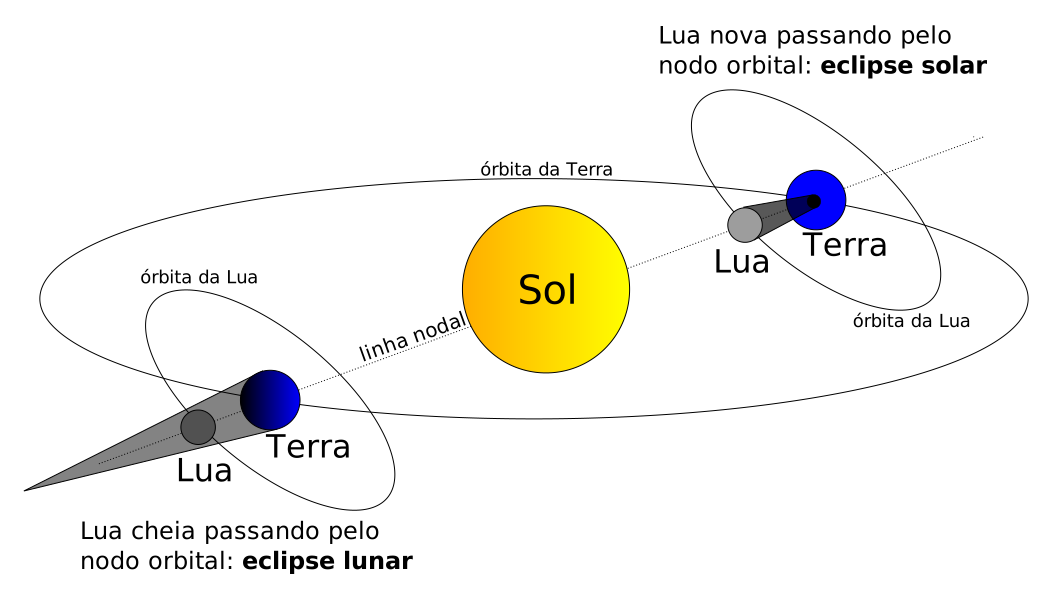
The Moon’s orbital plane is tilted by about 5.145 degrees relative to the ecliptic, the plane of Earth’s orbit around the Sun. The two points where those planes intersect are called the lunar nodes.
The ascending node is where the Moon crosses from south to north of the ecliptic. The descending node is the opposite crossing. Astrology commonly calls them the North Node and South Node.
The astronomy is simpler than the astrology
Physically, the nodes are calculated intersection points in the Moon’s orbit. Ideas that the North Node describes destiny, soul purpose or future growth belong to astrological and spiritual traditions rather than astronomy.
Why modern astrologers call the North Node a direction of growth
Different schools of astrology do not interpret the lunar nodes in exactly the same way.
Indian astrology has a long and complex tradition surrounding Rahu and Ketu. In modern Western and evolutionary astrology, one common approach treats the South Node as familiar territory and the North Node as a developmental direction that requires more conscious practice.
Some astrologers use reincarnation language and connect the South Node with past-life experience. Others prefer psychological language and interpret it as a cluster of established habits, strengths and default reactions.
Astrologer Pam Gregory places particular emphasis on the nodal axis and describes it through the soul’s journey, purpose and movement toward fulfillment. Her book How to Co-Create Using the Secret Language of the Universe develops that framework.
You do not need to accept reincarnation literally to find the model interesting. A more neutral version of the question is simply: which qualities already feel automatic, and which qualities seem to ask more of me?
North Node meanings through the 12 signs
The following interpretations use a modern evolutionary-style framework. The full chart matters, particularly the Node’s house, aspects and ruling planet.
North Node in Aries
Growth is often framed around initiative, courage, self-definition and acting without needing unanimous approval. With the South Node in Libra, cooperation and awareness of other people’s needs may feel familiar. The developmental tension is not to reject partnership but to notice where constant accommodation has become avoidance of your own direction.
North Node in Taurus
Taurus emphasizes stability, values, embodiment, patience and building something dependable. Scorpio South Node symbolism can describe familiarity with intensity, crisis, psychological depth or entanglement. The growth question becomes: can depth coexist with simplicity? Can safety be created without emotional turbulence being required to make life feel meaningful?
North Node in Gemini
Gemini asks for curiosity, listening, conversation and a willingness to keep learning. Sagittarius South Node symbolism can bring confidence in a larger worldview, philosophy or truth. The growth edge is to remain open to the detail that complicates the theory. Instead of always broadcasting the conclusion, ask another question.
North Node in Cancer
Cancer highlights belonging, emotional honesty, care, home and receptivity. Capricorn South Node themes may make achievement, control, competence or responsibility especially comfortable. Growth does not require abandoning ambition. It asks if vulnerability and emotional connection can exist alongside it.
North Node in Leo
Leo asks for heart, creative visibility, personal warmth and the willingness to take up some space. Aquarius South Node symbolism can feel comfortable observing from the group, identifying with collective causes or remaining slightly detached. The growth edge is personal expression: not just what the community thinks, but what you uniquely want to create.
North Node in Virgo
Virgo emphasizes discernment, craft, useful routines, practical service and attention to what works. Pisces South Node symbolism can feel intuitive, imaginative and compassionate but may also become diffuse. The developmental question is how to give shape to sensitivity without reducing everything mysterious to a checklist.
North Node in Libra
Libra emphasizes reciprocity, cooperation, negotiation and the ability to genuinely consider another person’s perspective. Aries South Node symbolism may make independent action instinctive. The invitation is not dependence. It is the discovery that another person can add information, challenge blind spots and participate in a decision without erasing you.
North Node in Scorpio
Scorpio moves toward depth, vulnerability, transformation and realities that cannot always be controlled through material stability. Taurus South Node themes can bring strong instincts for preservation, comfort and self-reliance. The growth edge may involve sharing, trusting, confronting complexity and allowing an old attachment to change.
North Node in Sagittarius
Sagittarius asks for synthesis, meaning, exploration and the courage to develop a wider worldview. Gemini South Node symbolism can collect information endlessly. The growth task is not to stop asking questions but to discover which pieces belong together and which principles you are prepared to live by.
North Node in Capricorn
Capricorn emphasizes responsibility, structure, self-governance and building something that survives changing moods. Cancer South Node symbolism may make emotional familiarity, family patterns or protective retreat especially strong. Growth often involves becoming your own authority without losing the capacity to care.
North Node in Aquarius
Aquarius shifts attention toward community, networks, systems, innovation and contributing something to a larger whole. Leo South Node symbolism can bring a developed individual creative identity or desire for recognition. The growth question becomes: how can individuality serve something beyond personal applause?
North Node in Pisces
Pisces emphasizes imagination, compassion, surrender, mystery and the ability to tolerate what cannot be perfectly controlled. Virgo South Node symbolism can be skilled, precise and analytical but may become overmanaged or perfectionistic. The invitation is not to abandon discernment. It is to recognize where analysis has reached its limit and some uncertainty must remain.
North Node meanings through the 12 houses
The sign describes the style of development. The house describes the area of life in which an astrologer expects that developmental tension to show up most clearly.
North Node in the 1st house
Themes of identity, autonomy and self-definition become central. Growth often involves becoming more willing to make choices from an internal sense of direction rather than defining yourself primarily through relationships, approval or what other people expect.
North Node in the 2nd house
Attention turns toward personal values, resources, skills and stability. Development can involve building something of your own, clarifying what is truly valuable and reducing unnecessary dependence on other people’s emotional or material resources.
North Node in the 3rd house
Curiosity, conversation, listening and everyday learning become important. The person may be encouraged to exchange ideas rather than rushing toward one grand conclusion. Nearby environments, writing, siblings, study and communication can become meaningful arenas for growth.
North Node in the 4th house
Home, emotional foundations, family patterns and private life move toward the center. Growth can involve building inner security rather than relying entirely on achievement, reputation or public recognition to provide a sense of worth.
North Node in the 5th house
Creative expression, play, romance and personal authorship become important. Development can involve stepping out from behind a group identity and allowing yourself to create, perform, love or take a personal risk simply because something matters to you.
North Node in the 6th house
Daily life becomes the practice ground. Routines, work, skills, service and practical maintenance receive attention. Growth often comes through turning vague intentions into repeatable habits and learning that small improvements can matter more than dramatic inspiration.
North Node in the 7th house
Partnership becomes a major developmental arena. The person may be asked to move beyond reflexive self-reliance and discover how negotiation, reciprocity and another person’s reality can deepen rather than diminish individuality.
North Node in the 8th house
Trust, intimacy, psychological depth and shared resources take on greater importance. Development may involve allowing life to become more complex than self-sufficiency alone can accommodate, including learning when support, vulnerability or collaboration is appropriate.
North Node in the 9th house
The person is drawn toward wider frameworks of meaning: philosophy, travel, higher learning, spirituality, publishing or cultural exploration. The challenge is often to move beyond fragments of information and develop a worldview spacious enough to guide action without becoming dogmatic.
North Node in the 10th house
Vocation, public responsibility and direction become central themes. Growth can involve leaving excessive dependence on private familiarity and accepting greater responsibility for what you want to build, contribute or become known for.
North Node in the 11th house
Community, collaboration, friendship and long-term vision become developmental themes. The person may move from a strong focus on personal recognition toward discovering how an individual talent can participate in something larger.
North Node in the 12th house
Inner life, retreat, imagination, surrender and the limits of control become important. Development can involve loosening compulsive management of every detail and allowing space for reflection, contemplation and experiences that cannot be reduced to productivity.
Advertisement
Want another perspective on your chart questions?
If you enjoy exploring astrology and spiritual guidance through conversation, Oranum offers live readers across astrology and related categories. Treat a reading as reflection or entertainment rather than a substitute for medical, legal, financial or mental-health expertise.
The North Node is a compass in some astrology — not a command
The language of destiny can become heavy very quickly.
If a North Node interpretation becomes another way to tell yourself that you chose the wrong career, married the wrong person or failed a spiritual mission, loosen your grip on the interpretation.
A healthier use of the symbol is exploratory. The North Node can function as a prompt for qualities and life areas that may deserve more conscious development. It does not need to become a celestial performance review.
The same principle applies to the 2026–2027 transits. Astrology can suggest themes without deciding the quality of your response. A difficult-looking chart does not remove choice. A harmonious-looking chart does not perform the work for you.
Why your Moon and rising sign can add more detail than a generic horoscope
Sun-sign astrology is popular because everybody can identify their Sun sign from a birth date. A complete natal chart contains much more information.
The Moon changes signs much faster than the Sun and is interpreted astrologically through emotional rhythms, instinctive responses, comfort and habitual needs.
The Ascendant or rising sign depends on the time and location of birth and establishes the orientation of the houses in most natal-chart systems.
That is one reason two people with the same Sun sign can receive very different astrological interpretations of the same collective transit.
Birth time matters particularly for the Ascendant and houses. If a birth time is unknown or approximate, a responsible interpretation should not pretend that a precise rising sign or house placement is certain.
A 2026–2027 rising-sign map
One practical way astrologers personalize these collective transits is by placing Aries, Gemini and Aquarius into the houses of your chart. The overview below uses whole-sign houses for simplicity. Other house systems can place planets differently, and exact degrees and natal aspects matter more than any short summary.
Aries rising
Saturn and Neptune in Aries emphasize the first house of identity, body and personal direction. Uranus in Gemini activates communication, learning and the immediate environment through the third house. Pluto in Aquarius works through the eleventh house of friendships, networks, communities and long-term aspirations. Symbolically, this can look like a major rewrite of identity occurring alongside changes in communication and belonging.
Taurus rising
Aries becomes the twelfth house, so Saturn–Neptune themes can be interpreted through retreat, endings, solitude, the unconscious or spiritual practice. Uranus in Gemini moves through the second house of resources and values, while Pluto in Aquarius transforms the tenth house of career and public direction. Inner restructuring and material priorities may become closely connected.
Gemini rising
Uranus moving through Gemini brings the disruptive planet into the first house in this system, making independence, experimentation and changing self-presentation especially visible themes. Saturn and Neptune in Aries occupy the eleventh house of communities and aspirations. Pluto in Aquarius moves through the ninth house of worldview, higher education, belief and exploration.
Cancer rising
Aries occupies the tenth house, placing Saturn–Neptune symbolism in the public and vocational sphere. Gemini becomes the twelfth, giving Uranus a more private or behind-the-scenes expression. Aquarius is the eighth house, where Pluto is interpreted through intimacy, shared resources, trust and psychological depth. Public direction may be changing at the same time as deeper questions about dependence and vulnerability.
Leo rising
Saturn and Neptune in Aries activate the ninth house of beliefs, study and perspective. Uranus in Gemini moves through the eleventh house of friendship and community, while Pluto in Aquarius occupies the seventh house of partnership. Worldview, social network and close relationships can all become sites of meaningful revision.
Virgo rising
Aries falls in the eighth house, drawing Saturn–Neptune themes toward trust, vulnerability, shared finances and emotional entanglement. Uranus in Gemini activates the tenth house of career and public direction, while Pluto in Aquarius moves through the sixth house of work and daily systems. Career changes can become inseparable from changing routines, boundaries and obligations.
Libra rising
Aries becomes the seventh house of partnership, so Saturn and Neptune may symbolize a period of bringing relationship ideals into clearer contact with reality. Uranus in Gemini moves through the ninth house of worldview and exploration. Pluto in Aquarius occupies the fifth house of creativity, romance and self-expression.
Scorpio rising
Saturn and Neptune in Aries occupy the sixth house of work, routines and daily maintenance. Uranus in Gemini moves through the eighth house of shared resources and intimacy. Pluto in Aquarius enters the fourth house of home, roots and family. The astrology becomes foundational here: ordinary routines, deeper dependencies and the meaning of home may all be undergoing revision.
Sagittarius rising
Aries is the fifth house, connecting Saturn–Neptune symbolism with creativity, pleasure, romance and self-expression. Uranus in Gemini moves through the seventh house of partnership. Pluto in Aquarius operates through the third house of communication and everyday thought patterns. Creative vision and changing relationships may reshape the way you speak and listen.
Capricorn rising
Aries becomes the fourth house of home, family and foundations, making Saturn–Neptune particularly relevant to questions of what “home” means and which structures remain workable. Uranus in Gemini moves through the sixth house of work and routine. Pluto in Aquarius travels through the second house of money, resources and values.
Aquarius rising
Pluto in Aquarius is moving through the first house, making identity and personal power major long-term themes in a whole-sign interpretation. Saturn and Neptune in Aries occupy the third house of communication and learning. Uranus in Gemini moves through the fifth house of creativity, romance and play. The invitation is to notice which versions of yourself are fading and what new language and expression are emerging.
Pisces rising
Saturn and Neptune move into the second house in a whole-sign chart, shifting attention toward resources, self-worth and values. Uranus in Gemini travels through the fourth house of home and family, while Pluto in Aquarius occupies the twelfth house of endings, private transformation and unconscious material. The symbolism points toward redefining what truly supports you.
A practical 2026–2027 timeline
It can help to replace vague “something huge is coming” language with a simple timeline.
- January 2026: Neptune begins its longer stay in Aries.
- February 20, 2026: Saturn and Neptune perfect their conjunction at 0°45′ Aries.
- Late April 2026: Uranus returns to Gemini.
- July 10–25, 2026: Uranus, Neptune and Pluto form one of their tightest three-planet windows.
- July 18–22, 2026: Jupiter briefly completes the striking four-planet configuration.
- June 2027: Uranus, Neptune and Pluto tighten again, with several exact aspects clustering during the month.
- August 2, 2027: a total solar eclipse crosses parts of southern Europe, North Africa and the Arabian Peninsula.
- 2028 and beyond: portions of the slow outer-planet story continue; 2027 is not a hard endpoint.
A timeline like this makes the scale clearer. We are looking at overlapping cycles, not one apocalyptic date circled in red.
Why does time seem to be speeding up?
The feeling that time is accelerating appears frequently in spiritual conversations, but it is not limited to spiritual communities.
Modern life contains more notifications, faster news cycles, constant digital availability and fewer natural stopping points. Novelty and divided attention can affect how a period is remembered. Age can influence subjective time perception. Stress, sleep, routine and emotional intensity can all alter the felt pace of a day or year.
A spiritual interpretation may describe the same sensation as accelerated energy or a shift in consciousness. That is a metaphysical framework rather than a measured change in the rate at which physical time passes.
The experience itself does not need to be dismissed simply because explanations differ. “Life feels impossibly fast right now” can be a real human experience even when people disagree about the cause.
Feeling more sensitive does not mean every symptom is an energetic upgrade
Contemporary spiritual communities sometimes connect insomnia, tinnitus, dizziness, headaches, fatigue, body aches, emotional volatility or unusual sensations with “ascension symptoms,” incoming frequencies, DNA changes or the development of a light body.
Those explanations are not established medical science.
A person can value spiritual interpretation and still take a physical symptom seriously. Persistent tinnitus deserves appropriate evaluation. New dizziness can have ordinary medical causes. Major sleep disruption should not automatically be interpreted as evidence of spiritual advancement.
Grounded spirituality
- A spiritual meaning does not rule out a physical cause.
- Astrology should not be used to diagnose symptoms.
- Seeking medical help does not make a spiritual experience less meaningful.
- Urgent or serious symptoms deserve appropriate professional care rather than an astrological explanation.
This is one of the most useful places to let belief and evidence occupy separate containers. They can coexist without one pretending to be the other.
For a wider look at the difference between spiritual interpretation, synchronicity, psychological change and ordinary life transition, see Mindelly’s guide to spiritual awakening signs and the feeling that life is about to change.
Stillness may be the most practical idea in the whole conversation
Among all the language surrounding timelines, planetary cycles and collective awakening, one idea remains useful even if you believe none of the metaphysics: create periods in which nothing is demanding an immediate reaction from you.

Stillness can mean meditation. It can mean sitting with tea and no phone. It can mean walking without headphones, writing by hand, gardening, praying, breathing quietly before answering an upsetting message or refusing another hour of alarming headlines before bed.
Research summarized by the U.S. National Center for Complementary and Integrative Health suggests possible benefits from meditation and mindfulness for stress, anxiety and sleep in some contexts, although evidence varies by outcome and practice. Meditation is not universally positive for every person, either; a review cited by NCCIH found negative effects in about 8 percent of participants across the studies it examined.
Stillness does not need to become another spiritual achievement. Five quiet minutes are not a failed version of an hour-long practice.
A simple zero-noise practice
For ten minutes, remove incoming information. No news, podcast, reading, notifications or spiritual teaching. Notice what remains when nobody is telling you what the moment means. You may discover anxiety, boredom, relief, an idea you have been avoiding or simply quiet. None of those outcomes needs to be mystical to matter.
Galactic consciousness: literal belief, mystical experience or metaphor?
One of the more expansive ideas appearing in contemporary spiritual discussion is that humanity is developing a greater awareness of itself as “galactic.” Different people mean very different things by that phrase.

For one person, galactic consciousness is metaphorical: a reminder that Earth is one planet in an immense universe and that human identity need not stop at national or cultural boundaries.
For another, it describes mystical states, unusual dreams, channeling experiences or a felt connection with intelligences beyond ordinary human awareness.
Others take the idea literally and believe benevolent extraterrestrial or multidimensional beings are communicating with humanity.
Those literal contact claims have not been established by scientific evidence. A vivid dream, channeling experience, meditation vision or powerful sense of presence can be personally meaningful without proving the external origin a person attributes to it.
You do not have to choose between ridicule and certainty
It is possible to say, “That experience was extraordinary and meaningful to me,” while also saying, “I do not know exactly what caused it.”
That middle ground protects curiosity. It also protects you from people who insist that their interpretation of an unverifiable experience gives them authority over your decisions.
What about the “light body”?
The light body is a spiritual concept found in different forms across modern metaphysical communities and influenced by older religious, esoteric and mystical ideas about subtle bodies, transformation and consciousness.
Modern teachers do not all mean the same thing by it. Some use “light body” symbolically for a less fear-driven, more compassionate state of being. Others describe an energetic structure surrounding or interpenetrating the physical body. Still others make literal claims about changes to human cells or DNA.
The biological version is where caution becomes important. There is no established scientific evidence that the 2026–2027 planetary configurations are transforming human DNA into a new light body, nor that physical symptoms can be reliably interpreted as proof of such a process.
As metaphor, however, the concept creates a worthwhile question: what would it mean to become less organized around fear, compulsion and defensiveness and more organized around awareness, compassion and deliberate choice?
That transformation is difficult enough without requiring a new form of biology.
Astrology can describe a pattern without determining how you play it
One of the most useful approaches to astrology treats the chart as a field of possibilities rather than a sentence.
Mars symbolism can be expressed as courage, initiative and direct action or as impulsiveness and unnecessary conflict. Saturn can become discipline or excessive rigidity. Neptune can inspire imagination or fog judgment. Uranus can liberate or destabilize. Pluto can expose what needs transformation or intensify struggles over control.
The archetype does not tell us which expression we must choose.
That principle becomes especially important when astrology turns frightening. If someone tells you that a transit guarantees divorce, death, financial ruin, illness or another catastrophe, certainty has outrun what astrology can responsibly support.
Reader tip
- Prefer possibilities over guaranteed predictions.
- Ask what choices remain available to you.
- Be cautious when fear is used to sell more readings.
- Do not hand a reader control over medical, legal or financial decisions.
- A useful reading should leave you with more agency, not less.
What “choose your timeline” can mean without taking it literally
Timeline language has become common in manifestation and spiritual communities. Taken literally, it can imply that multiple realities are available and consciousness selects the one we enter.
That metaphysical claim is not established by physics simply because quantum mechanics contains unusual phenomena. Quantum terminology is frequently borrowed into spirituality in ways that go far beyond what the science demonstrates.
But timeline language works very well as a psychological metaphor.
Every meaningful choice closes some paths and opens others. If you stop feeding one conflict, your future changes. If you learn a skill for three years, you arrive somewhere different from the version of you who never began. If you leave a damaging pattern, save consistently, repair a relationship or commit to creative work, your life develops along another path.
That is enough to make the question powerful: which future are my present habits making more likely?
A different symbolic lens: 2026 and 2027 in numerology
Astrology is not the only spiritual system framing this period as a transition.
In common modern numerology, 2025 reduces to 9, a number associated with completion and release. The digits of 2026 total 10 and reduce to 1, commonly associated with initiation and a new cycle. The digits of 2027 total 11, which some numerology traditions preserve as a Master Number while also acknowledging its root of 2.
That creates a symbolic sequence many seekers find interesting: completion, beginning, then heightened 11/2 themes such as sensitivity, relationship and inspired perception.
It is a separate symbolic system, not proof that the astrological interpretation is objectively correct. If you want to understand how the calculations work, Mindelly’s complete numerology guide explains Life Path numbers, Personal Years, Master Numbers and common calculation methods.
How to work with 2026–2027 without living in prediction mode
You do not need to monitor every transit. You do not need to understand every degree. And you do not need to spend two years waiting for the world to reveal which astrologer was right.
The bigger transits can instead become prompts for periodic reflection.
Ask a Pluto question
Where is power operating invisibly in my life? What am I afraid to lose? Which structure no longer works simply because I have become accustomed to it?
Ask a Uranus question
Which assumption needs to be questioned? Where has routine stopped being useful? What could I experiment with before committing to a complete upheaval?
Ask a Neptune question
Which dream deserves more attention? Where am I idealizing something because reality is uncomfortable? What helps me distinguish intuition from wishful thinking?
Ask a Saturn question
What requires patience? Which boundary needs strengthening? What would disciplined progress look like if I stopped expecting immediate results?
Ask a North Node question
What quality or life area keeps calling me forward even though it is less comfortable than what I already know?
A simple quarterly practice for this period
Instead of checking astrology every day, consider a slower rhythm. Once every three months, take half an hour and review what is actually changing in your life.
Six questions for a 2026–2027 check-in
- What has become clearer since my last check-in?
- What structure is becoming less sustainable?
- Where am I experimenting with something new?
- Which fear is asking for evidence rather than imagination?
- What deserves greater commitment?
- What can I stop carrying simply because it has become familiar?
You can add the current transits afterward if that is useful. Beginning with lived experience keeps astrology in a supporting role rather than forcing life to imitate a prediction.
You are allowed to disengage from collective fear
One of the most psychologically useful ideas in spiritual conversations about this period is the permission to stop treating every disturbing event in the world as something your nervous system must process continuously.
Being informed and being saturated are not the same thing.
You can care about politics, conflict, climate, economics, technology and other people’s suffering without consuming a live feed of distress from morning until sleep. Reducing exposure to repetitive alarming content is not the same as pretending difficult realities do not exist.
If “that is happening, but I do not have to live inside it every minute” is what someone means by choosing a different timeline, the language may be metaphysical but the boundary is practical.
What a good astrology or spiritual reading should do during uncertain times
Periods of uncertainty naturally increase the desire for answers. That makes them exactly the wrong time to hand complete authority to somebody simply because they claim intuitive certainty.
A thoughtful reader can help you explore symbolism, clarify the question underneath the question and notice possibilities you have not considered. They may explain transits, cards, intuitive impressions or another spiritual framework. The reading can be meaningful without becoming an order.
Be wary of anyone who says you must pay for repeated sessions to prevent a curse, remove dangerous energy, guarantee a relationship, avoid disaster or discover exactly what medical, legal or financial decision to make.
If you choose to explore a live reading, see how Oranum’s live-reading environment works and decide if that format suits the kind of reflection you want.
Advertisement
Find a reader whose style fits your question
Different seekers want different things from a reading. Some prefer astrology, others tarot or intuitive conversation. If you decide to explore a session, compare readers and choose a style that feels useful without surrendering your own judgment.
Questions worth bringing to a reading
- Which current transit seems most personally relevant to my chart?
- What themes might I explore instead of asking for a guaranteed event?
- Where am I repeating a familiar South Node pattern?
- What would a constructive expression of this transit look like?
- Which parts of this interpretation depend on my exact birth time?
- What practical choices remain mine regardless of the astrology?
Frequently asked questions about the 2026–2027 astrology
Is the 2026–2027 planetary pattern really unprecedented?
It is safer to call it rare than unprecedented. Astrodienst’s analysis identifies a similar but less exact Uranus–Neptune–Pluto configuration around 1505–1515. The July 2026 addition of Jupiter created a particularly striking four-body geometry, but claims that nothing comparable has ever occurred require more evidence than is usually provided.
What was special about July 2026?
The long-running Uranus–Neptune–Pluto pattern became very precise, and Jupiter briefly connected with all three planets. July 18–22 was the tightest four-planet phase highlighted in Astrodienst’s analysis.
What happens in June 2027?
Uranus, Neptune and Pluto again form a very tight double-sextile-and-trine pattern, particularly around June 10–18. Several exact aspects cluster around that period, but the larger cycle extends beyond the month.
Does something have to happen on the exact date of an aspect?
No. Even within astrology, slow-planet aspects are commonly treated as extended periods because planets approach, perfect, separate and often repeat the same aspect after retrograde motion. Exact dates are anchors rather than guaranteed event deadlines.
What is the North Node physically?
It is the ascending intersection between the Moon’s orbital plane and the ecliptic. It is a calculated point rather than a physical planet. Its interpretation as destiny, growth or soul direction belongs to astrology.
Do I need my exact birth time?
A reliable birth time is important for the Ascendant and houses. Many planetary positions can still be calculated without an exact time, although the Moon can also change signs during a day.
Can astrology explain insomnia, dizziness or tinnitus during this period?
There is no established medical evidence that the current planetary alignments cause those symptoms. Persistent, severe, new or concerning symptoms deserve appropriate healthcare rather than an assumed energetic explanation.
Should I be afraid of 2027?
No astrological configuration justifies treating 2027 as a guaranteed catastrophe. It contains noteworthy planetary patterns and eclipses, but astrology cannot establish that a particular disaster or spiritual event must occur.
Sources and further reading
For the outer-planet timing, Astrodienst’s published analysis of the 2024–2029 Uranus–Neptune–Pluto pattern provides a detailed overview of the tight 2025, 2026 and 2027 windows. Astrodienst’s material on the Saturn–Neptune cycle records the exact conjunction at 0°45′ Aries on February 20, 2026.
For eclipse timing, NASA’s current Future Eclipses page provides the main public schedule. NASA GSFC’s technical catalog additionally contains the extremely marginal July 18, 2027 penumbral event discussed above.
For scientific context on astrology, Shawn Carlson’s 1985 double-blind experiment in Nature remains one of the best-known controlled studies.
For the modern evolutionary interpretation of the nodal axis as a path of soul development, Pam Gregory’s published work offers one contemporary example. Other Western astrologers and Indian astrological traditions may interpret the lunar nodes differently.
For meditation and mindfulness, the U.S. National Center for Complementary and Integrative Health provides an evidence-focused overview of possible benefits, limitations and reported adverse experiences.
Maybe the real transition is not about predicting what comes next
It is tempting to look at a rare planetary pattern and ask the biggest possible question: what is going to happen to humanity?
Astrology cannot answer that with certainty.
But it can offer other questions that may be more useful.
What kind of person do you want to be when familiar structures change? What ideas deserve to become real rather than remaining aspirations? Where are you confusing fear with intuition? Which systems have too much power over your attention? What part of your life is asking for experimentation? What familiar pattern keeps you safe but small? What becomes audible when the noise stops?
The sky can be a mirror without becoming a dictator.
Perhaps that is the most grounded way to approach 2026 and 2027: remain curious about the pattern, humble about what we can prove, open to mystery and unwilling to surrender the part that still belongs to us — the choice of how we respond.
